Skip to content
Home » Archives for Anwar Hossain Mokhter

Anwar Hossain Mokhter

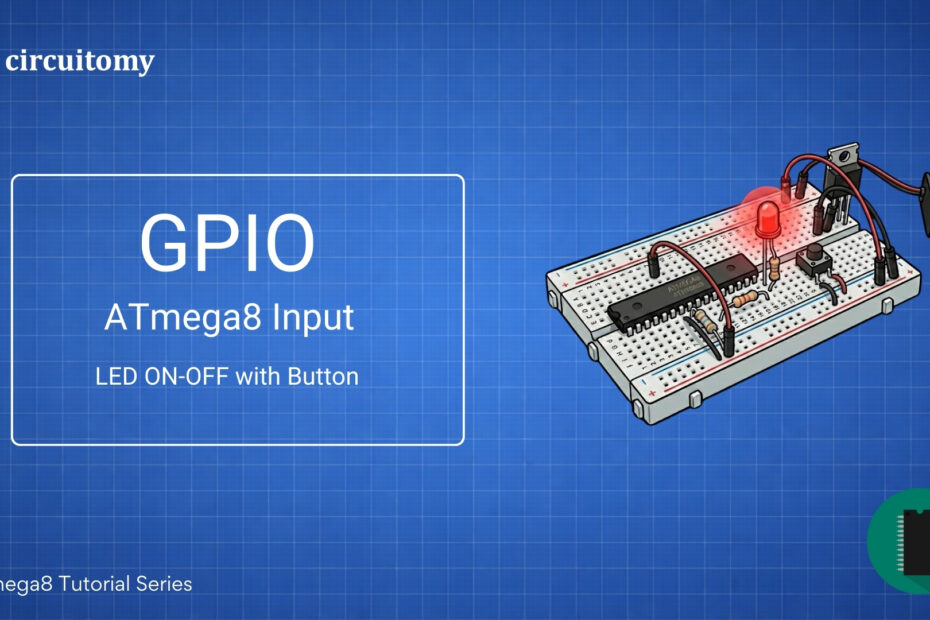
ATmega8 GPIO Input LED and Button Circuit Diagram – AVR Microcontroller Tutorial

LED and Button with ATmega8 – AVR GPIO Input Tutorial (Beginner Friendly)

  • 7 min read

Today, we will learn how to interface a push button with the Atmega8 microcontroller using a hardware pull-up resistor. This project will help you understand how microcontrollers read button inputs.Let’s break everything down in a simple way!A push button is a simple switch that connects or disconnects the circuit when you press it. Microcontrollers like… 

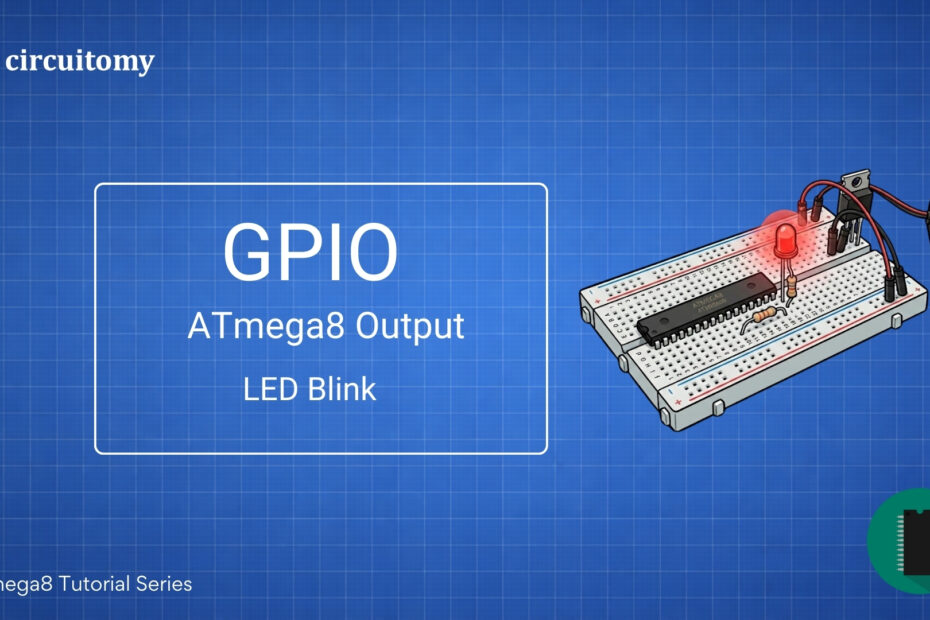
ATmega8 GPIO Output Circuit Diagram for LED Blink – AVR Microcontroller Project

LED Blink Using ATmega8 – AVR GPIO Output Tutorial (Beginner Friendly)

  • 3 min read

Blinking an LED is the simplest way to get started with ATmega8 programming. The basic steps are: • Configure a GPIO pin as output.• Turn the LED ON and OFF with a delay. Components Required • ATmega8 microcontroller• LED• 220Ω resistor (for current limiting)• AVR Programmer (like USBasp)• Breadboard and Jumper Wires• 5V Power Supply Programming Diagram Circuit Diagram… 

Understanding Data Types in Rust: A Beginner’s Guide with Examples

  • 3 min read

Data Types Rust’s type system ensures safety and efficiency, making it a powerful language for systems programming. This tutorial explores fundamental data types, compound types, and custom data types in detail. Fundamental Data Types Fundamental data types in Rust are divided into scalar and compound types. Scalar TypesScalar types represent a single value. 1. Unsigned… 

Constants vs Static Variables in Rust: Key Differences with Examples

  • 2 min read

Constants and Static Variable Constants (const) • Purpose: Compile-time fixed values that never change.• Memory Efficiency: • Constants are inlined at compile time, meaning the value is directly embedded wherever it’s used.• No separate memory allocation at runtime, making them highly efficient. • Use Case: Best for fixed, unchanging values like mathematical constants, configuration settings,… 

Understanding Outer and Inner Scopes in Rust: A Beginner-Friendly Guide to Variable Lifetimes

  • 3 min read

Outer and inner Scope In Rust, scopes determine the lifetime and visibility of variables. They help define where a variable can be accessed or modified and when it is created and destroyed. Scopes are created using curly braces { } and can be nested, forming inner and outer scopes. Outer Scope • Variables declared in… 

Rust Compile-Time vs Runtime: How Rust Ensures Safety and Speed

  • 3 min read

Runtime and  Compile-Time In Rust, the distinction between runtime and compile-time is crucial for understanding performance and safety. Here’s an explanation: 1. Compile-Time • Definition: The phase when the Rust compiler checks, analyzes, and translates your code into machine code before the program runs.• Purpose: Ensures that certain errors (e.g., type mismatches, borrow rules) are… 

Immutable Variables vs. Constants in Rust: When to Use Each

  • 4 min read

Immutable variables or constants The decision to use immutable variables or constants in Rust depends on the specific use case and the behavior you want to enforce in your program. Here’s a detailed explanation: When to Use Immutable Variables Immutable variables (let) are used when: 1. The value doesn’t need to change during the program’s… 

Immutable vs Mutable Variables in Rust: Understanding let and let mut

  • 4 min read

Immutable (let) and Mutable (let mut)  The choice between using immutable (let) and mutable (let mut) variables in Rust depends on whether the value of the variable needs to change during the program’s execution. Here’s a guide to help you decide: When to Use Immutable Variables (let) 1. Value Doesn’t Change • If the value… 

Learn Rust Variable Declaration: Ultimate Guide for Newbies

  • 3 min read

In Rust, variable declaration is straightforward but comes with some unique characteristics compared to other programming languages. Here’s an overview of how to declare and use variables in Rust: Variable Declaration Syntax The basic syntax for declaring a variable is: Key Features of Variable Declaration in Rust Immutable Variables (Default) • By default, variables in… 

AVR ATmega8 GPIO Pin Setup on Breadboard – Beginner's Microcontroller I/O Guide

How to Define and Setup AVR GPIO Pins: Beginner’s Guide to AVR Microcontroller I/O

  • 6 min read

The ATmega8 is a popular microcontroller from the AVR family by Microchip (formerly Atmel). It has 23 GPIO (General Purpose Input/Output) pins divided across three ports: PortB, PortC, and PortD. Below is a basic tutorial on how to configure and use GPIO pins on the ATmega8. 1. GPIO Ports in ATmega8 • PortB (PB0-PB7): 8…